

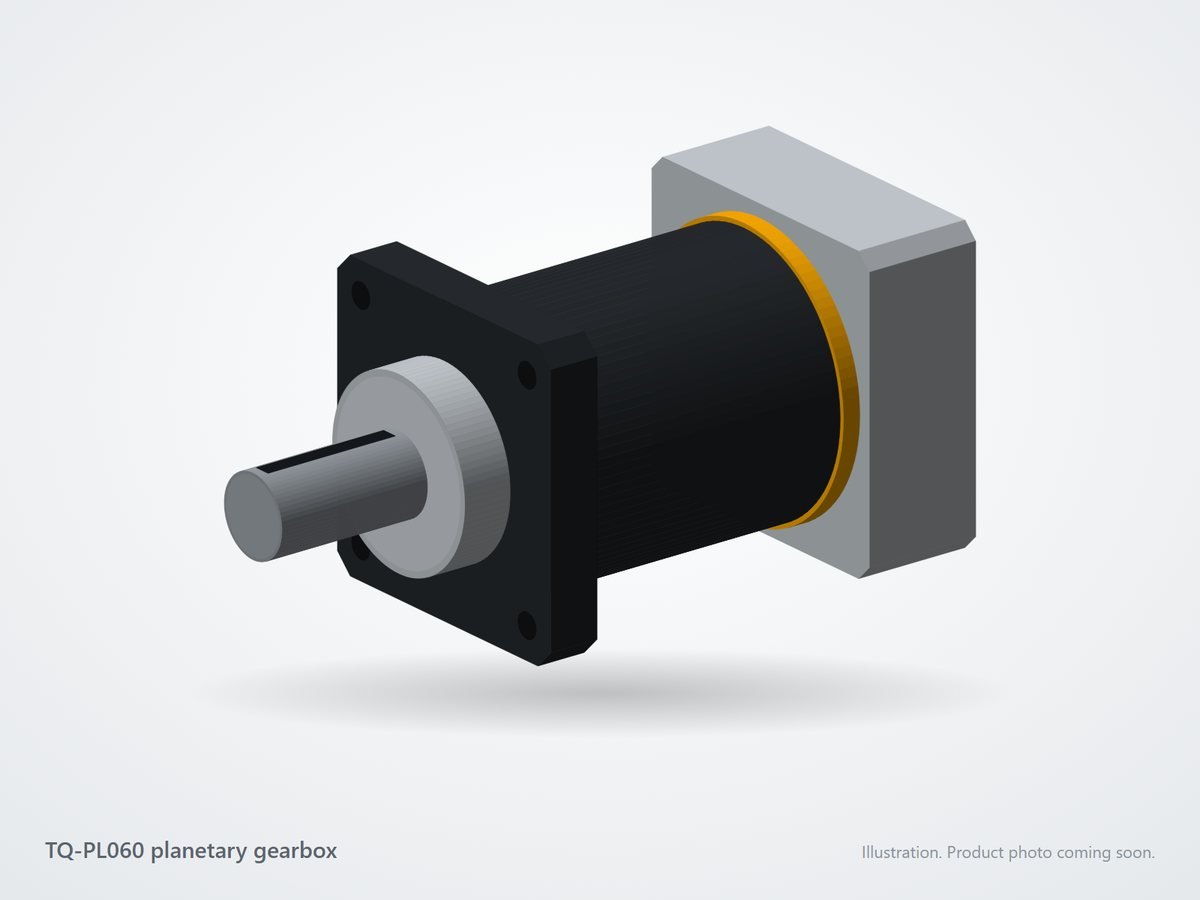
Planetary gearboxFrame 60
TQ-PL060 Precision Planetary Gearbox, 60 mm
- Rated torque
- 30 N·m
- Backlash
- ≤ 3 arcmin
- Ratios
- 3–100:1
from ₹14,500 + GST
In stockLow-backlash planetary gearboxes in 1 and 2 stages, ratios 3:1 to 100:1, with input flanges for any servo or stepper motor. Published torque, backlash and CAD for every frame size.
2 gearboxes
Planetary gearboxFrame 60
from ₹14,500 + GST
In stock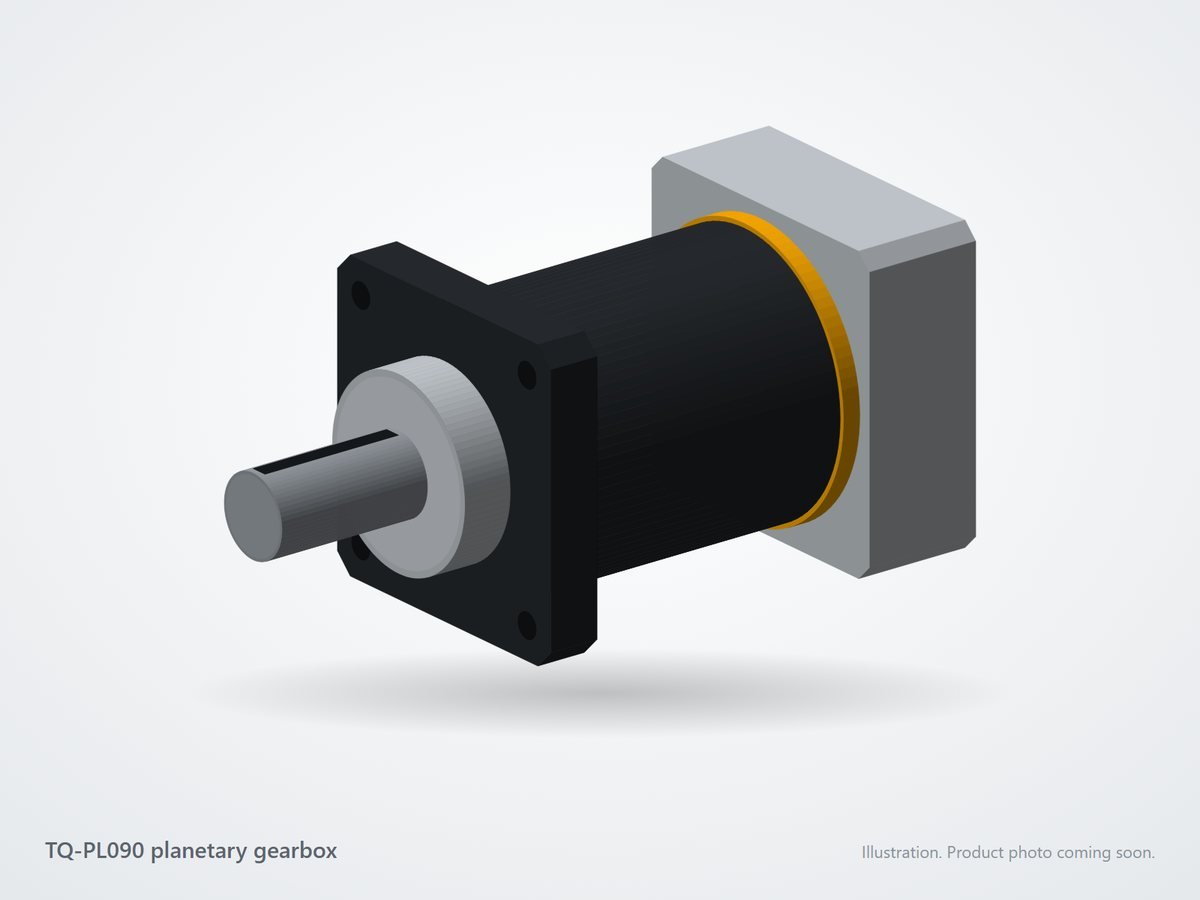
Planetary gearboxFrame 90
from ₹21,900 + GST
In stockNo gearbox matches these filters. Loosen the torque or backlash limit, or send us your requirement and we will build one.
Request a custom gearboxChange the sun and planet tooth counts and watch the carrier slow down. The ratio of one stage is 1 + ring teeth ÷ sun teeth, so a 12-tooth sun in a 48-tooth ring gives 5:1.
Turn on JavaScript to change tooth counts and see the ratio, output speed and torque update live.
Every planetary gearbox can be joined to any motor, robot joint or housing: we machine a custom coupling bored to both shafts, plus an adapter flange if the mounting faces differ. Send both shaft sizes, a drawing or just the motor model number.
Get a custom couplingA planetary (epicyclic) gearbox has a central sun gear on the motor shaft, three or four planet gears that mesh with it, and an internally toothed ring gear that is part of the housing. The planets are held by a carrier, which becomes the output. Because the ring is fixed, the planets roll around it and drag the carrier along at a lower speed. The reduction ratio of one stage is 1 + (ring teeth ÷ sun teeth), so a 12-tooth sun in a 48-tooth ring gives 5:1.
The load is shared between several planets, which is why a planetary gearbox carries more torque than a spur or worm gearbox of the same diameter. The input and output are on the same axis, so it bolts straight onto a servo motor without offsetting the machine layout.
Planetary gearboxes are the default choice for servo axes that need good accuracy at a reasonable price: gantry and Cartesian robots, rack-and-pinion drives, belt and ball-screw axes, packaging machines, conveyors and AGV wheel drives. They also reduce the reflected load inertia by the square of the ratio, which lets a small servo control a heavy axis without instability.
Start with the output speed you need and divide the motor's rated speed by it. Then check that motor torque × ratio × efficiency covers the load torque with margin. A good rule for dynamic servo axes is an inertia ratio (load inertia reflected to the motor ÷ motor inertia) below 10:1; the gearbox ratio is often chosen to achieve this.
Every Torqtron planetary gearbox uses a clamping hub on the input and a replaceable adapter flange, so the same gearbox fits servo motors from Yaskawa, Delta, Mitsubishi, Panasonic, Siemens, Inovance and others, as well as NEMA stepper motors. If your motor is not on our list, send its datasheet and we machine a flange to suit.
A step-by-step method to choose the ratio and frame size for a servo axis: speed, inertia ratio, peak and RMS torque, and emergency stop, worked for…
Wheel torque from rolling resistance, slope and acceleration, the ratio from travel speed, and the radial load check most designs miss. Worked for a…
A single stage covers ratios up to about 10:1 with the lowest backlash and highest efficiency. Ratios from 15:1 to 100:1 need two stages in series, which adds a little length, backlash and loss.
Pick the smallest frame whose rated output torque is at least your required torque times a service factor (1.25 for smooth loads, 1.5–2 for shock). Then check that the maximum input speed and the input flange suit your motor.
Yes. Our planetary gearboxes are lubricated for life with synthetic grease and can run horizontal, vertical up or vertical down.
Tell us the motor model, or the shaft diameter, pilot diameter and bolt circle. We supply a matching input flange and clamping hub, usually from stock drawings.