

 Zero-backlash class
 RV reducerFrame 20E
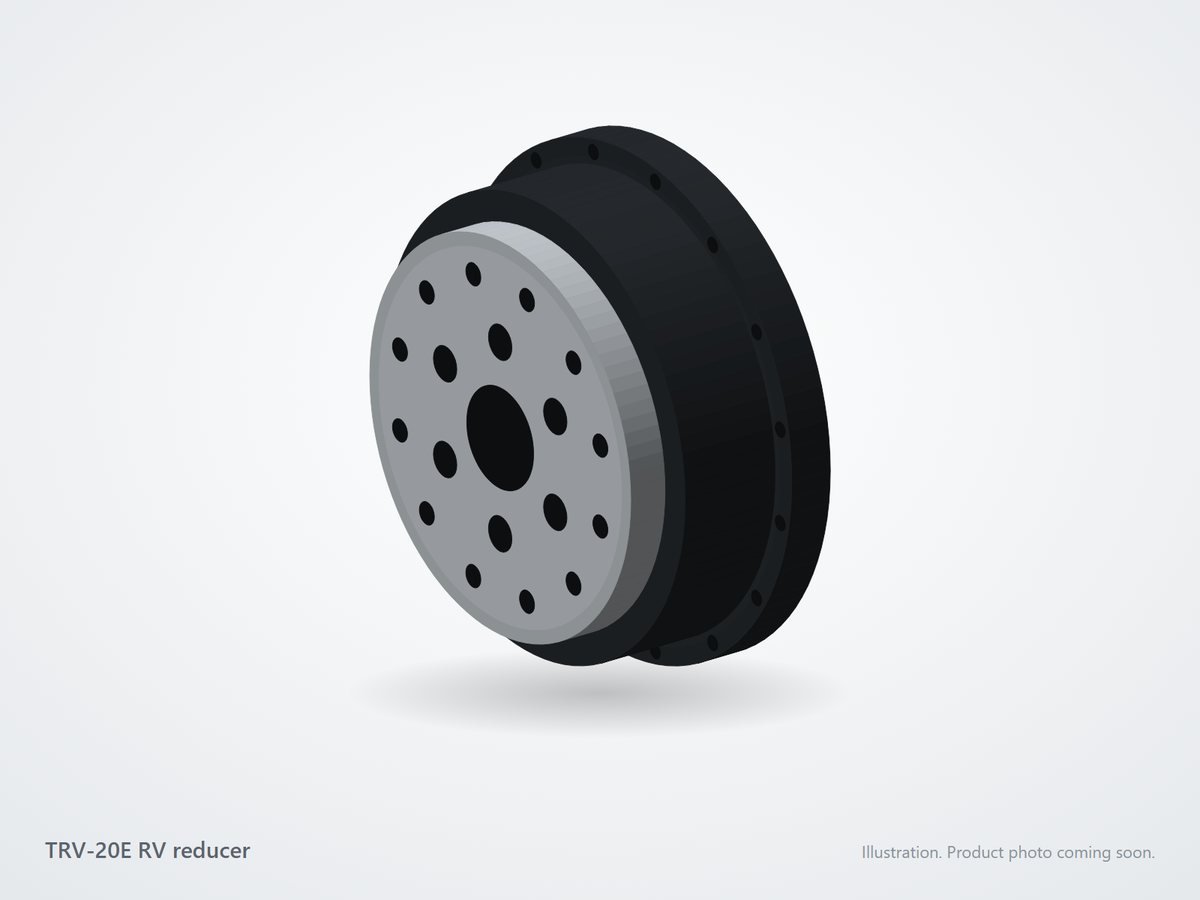
TRV-20E RV Reducer for Robot Joints
- Rated torque
- 167 N·m
- Backlash
- ≤ 1 arcmin
- Ratios
- 57–161:1
from ₹1,12,000 + GST
In stockTwo-stage RV (rotate vector) reducers with ≤ 1 arcmin backlash, very high torsional stiffness and shock capacity for robot bases, shoulders, elbows and positioners.
2 gearboxes
Zero-backlash class RV reducerFrame 20E
from ₹1,12,000 + GST
In stock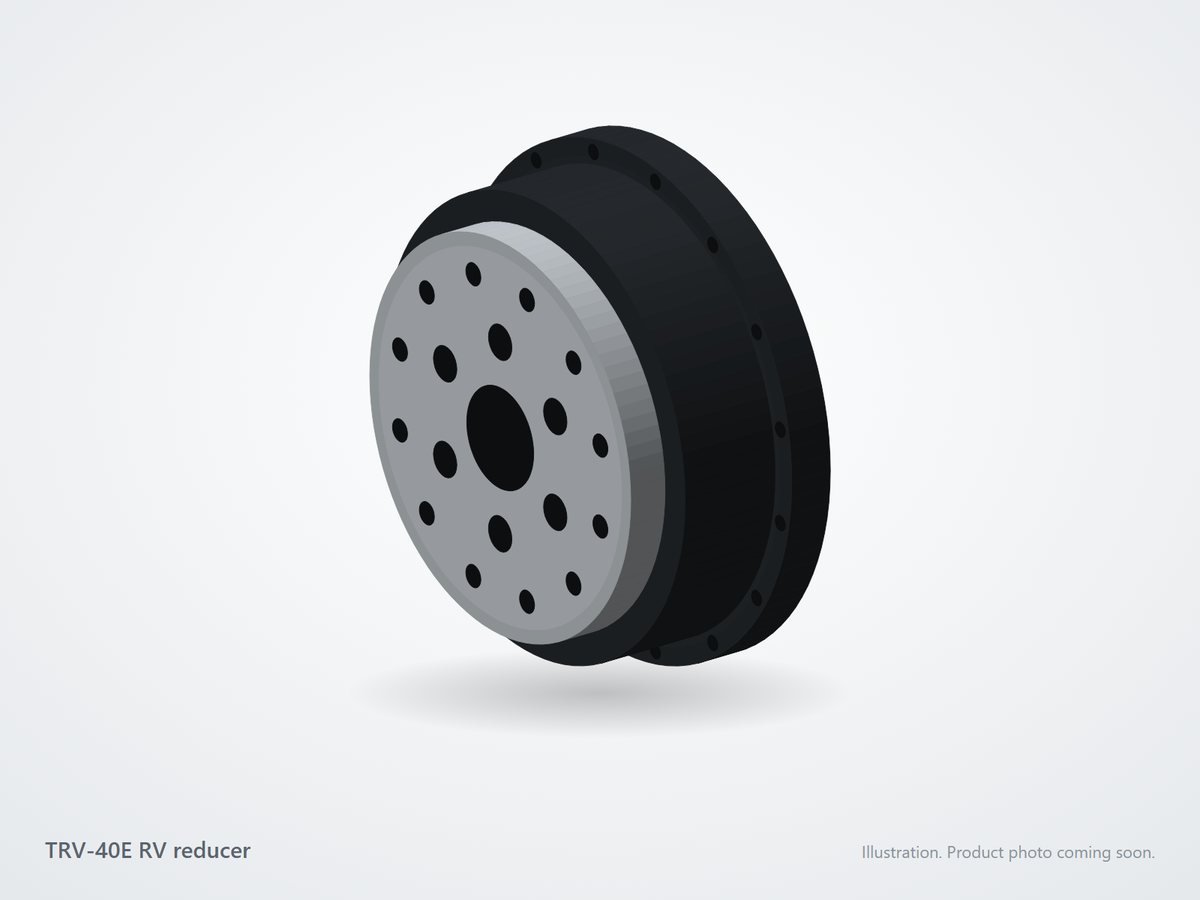 Zero-backlash class
 RV reducerFrame 40E
from ₹1,68,000 + GST
In stockNo gearbox matches these filters. Loosen the torque or backlash limit, or send us your requirement and we will build one.
Request a custom gearboxChange the sun, crank gear and pin counts. The spur stage and the cycloid stage multiply: ratio = 1 + (crank gear teeth ÷ sun teeth) × pin count, so 14, 30 and 20 give about 44:1.
Turn on JavaScript to change tooth counts and see the ratio, output speed and torque update live.
Every RV reducer can be joined to any motor, robot joint or housing: we machine a custom coupling bored to both shafts, plus an adapter flange if the mounting faces differ. Send both shaft sizes, a drawing or just the motor model number.
Get a custom couplingAn RV reducer has two reduction stages in one compact housing. In the first stage, a sun gear on the input shaft drives two or three spur gears. Each spur gear turns a crankshaft with two eccentric journals. In the second stage, those eccentrics push two cycloid discs, mounted 180° apart for balance, around a ring of pins in the housing. Each disc has one lobe fewer than there are pins, so it advances one pin pitch per crank revolution. The crankshafts are held by the output carrier, which turns slowly with high torque.
Multiplying the two stages gives ratios from about 30:1 to over 180:1. Because many pins and lobes carry load at once, and the discs roll rather than slide, the reducer is extremely stiff and survives shock loads that would damage a gear tooth.
In a six-axis robot, joints 1 to 3 carry the arm, the payload and the tilting moments of fast motion. RV reducers integrate large angular-contact bearings, so they carry these moments directly and the joint needs no extra support bearing. Their stiffness keeps the arm accurate at the tool point, and their low lost motion (≤ 1 arcmin) gives repeatable positioning. The same qualities suit welding positioners, turntables, ATC magazines and heavy indexing tables.
Build a load cycle for the joint: acceleration, constant speed, deceleration and dwell, with torque and speed for each segment. Calculate the average load torque and average output speed, compare them with the rated values, and check that the peak torque stays below the allowable acceleration torque. Then check the tilting moment against the bearing rating. Our engineers will do this check for free if you send the joint's load cycle.
How precision reducer life is rated, how to reduce a duty cycle to average torque and speed, and two worked life calculations for an RV reducer and a…
Which reducer goes in which joint of an articulated robot, typical ratios per axis, and a worked torque calculation for a 10 kg payload shoulder join…
Rotate Vector. The reducer combines a spur-gear first stage with a cycloidal second stage driven by crankshafts, which gives high ratios with very high stiffness.
The base, shoulder and elbow joints carry the full weight of the arm and payload plus large tilting moments. RV reducers have integrated angular-contact main bearings and share the load over many pins, so they handle these moments and emergency stops without a separate bearing.
Our E-series frames follow the widely used industry mounting dimensions for the same frame number, but always compare our 2D drawing with your existing part before ordering.
With grease filled at assembly. For continuous duty we recommend changing the grease every 20,000 hours or as specified in the manual.