Application: Mobile robots
Gearboxes for AGV and AMR drive wheels: a full sizing example
Wheel torque from rolling resistance, slope and acceleration, the ratio from travel speed, and the radial load check most designs miss. Worked for a 300 kg AMR.
Key takeaways
- Wheel torque = (rolling resistance + slope force + acceleration force) × wheel radius, shared by the driven wheels.
- Choose the ratio from top travel speed, leaving motor speed margin.
- Check the radial wheel load against the gearbox output bearing — it often decides the frame size, not torque.
The challenge
An AGV or AMR drive must start a loaded vehicle, climb ramps and dock accurately, while fitting under a low chassis. The gearbox multiplies a small servo's torque to wheel torque, and often carries the wheel's weight on its output bearing.
Worked example: 300 kg differential-drive AMR
Vehicle 100 kg plus 200 kg payload; two driven Ø150 mm polyurethane wheels and two casters; top speed 1.2 m/s; acceleration 0.5 m/s²; ramps up to 3° (about 5.2%); rolling resistance coefficient 0.02, a conservative figure for polyurethane on concrete.
| Force | Calculation | Result |
|---|---|---|
| Rolling resistance | 0.02 × 300 × 9.81 | 58.9 N |
| Slope | 300 × 9.81 × sin 3° | 154.0 N |
| Acceleration | 300 × 0.5 | 150.0 N |
| Total | 362.9 N |
| Item | Calculation | Result |
|---|---|---|
| Wheel torque | 362.9 ÷ 2 × 0.075 m | 13.6 N·m |
| Wheel speed | 1.2 ÷ (π × 0.15) × 60 | 152.8 rpm |
| Maximum ratio (3,000 rpm motor) | 3,000 ÷ 152.8 | 19.6:1 |
| Chosen ratio | Standard, with speed margin | 15:1 (motor 2,292 rpm) |
| Motor peak torque | 13.6 ÷ (15 × 0.94) | 0.97 N·m |
| Static wheel load (4 wheels) | 300 × 9.81 ÷ 4 | 736 N |
| With dynamic factor 1.5 | 736 × 1.5 | 1,104 N |
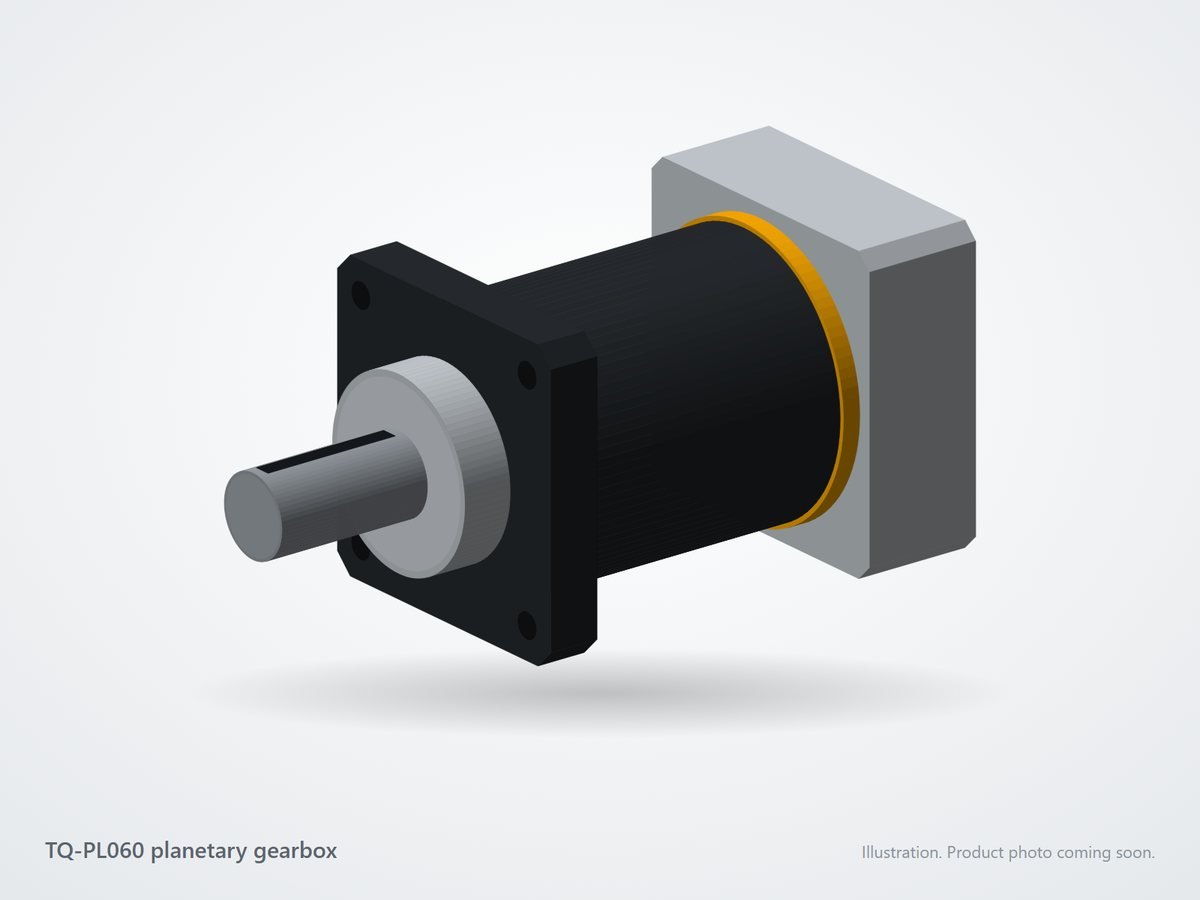
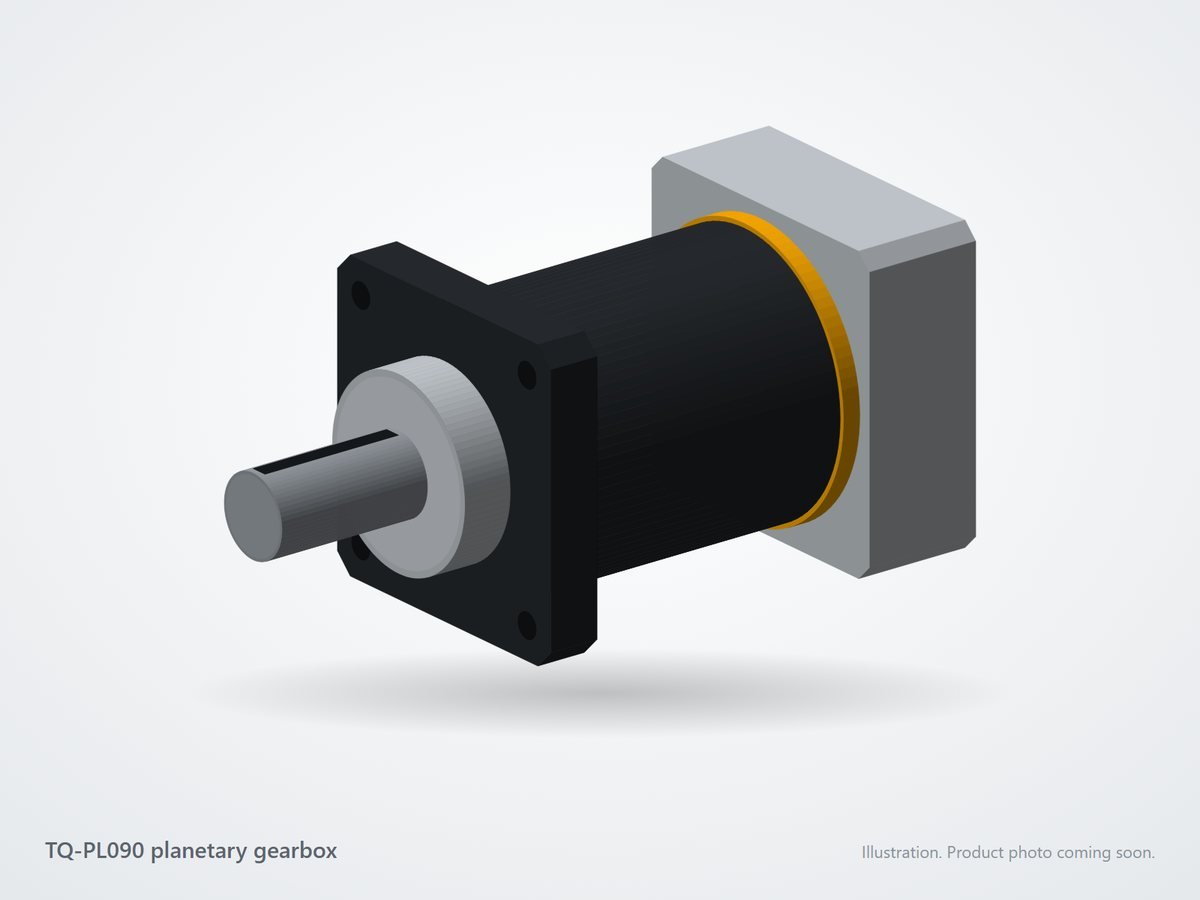
Torque is easy: a 400 W servo (1.27 N·m rated) on a 60 mm planetary gearbox at 15:1 covers the 0.97 N·m peak, and the gearbox sees only 13.6 N·m. The radial load is the real limit. 1,104 N is close to a typical 60 mm frame's 1,200 N output bearing rating, and the load acts further out when the wheel hub is offset. The robust choices are a 90 mm frame (about 3,200 N) or a wheel supported on its own bearings and driven through a coupling.
More design points
- Use a motor with a holding brake so the vehicle cannot roll on a ramp when powered off.
- Low backlash (≤ 5 arcmin) helps odometry and docking accuracy; the wheel's slip usually dominates beyond that.
- Seal to IP65 for washdown or dusty floors.
We make custom wheel hubs, motor-to-gearbox couplings and complete drive-module housings on order.
References and standards
- ISO 3691-4, Industrial trucks — Safety requirements and verification — Part 4: Driverless industrial trucks and their systems.
- ISO 281, Rolling bearings — Dynamic load ratings and rating life (basis for output bearing life).
Frequently asked questions
What gear ratio does an AGV drive need?
Divide the motor's rated speed by the wheel speed at top travel speed. For a 150 mm wheel at 1.2 m/s (about 153 rpm) and a 3,000 rpm motor, the maximum is about 20:1; 15:1 leaves speed margin.
Can the gearbox output bearing carry the wheel?
Only if its radial load rating covers the wheel load with a dynamic factor. Many planetary gearboxes are rated for 1 to 3 kN radially; heavy AGVs usually support the wheel on its own bearings and drive it through the gearbox shaft.
Should AGVs use a brake?
Yes. Mobile robots need a holding brake so they cannot roll on slopes when powered off, and safety standards for driverless trucks require controlled stopping.