

 Zero-backlash class
 Harmonic driveFrame 17
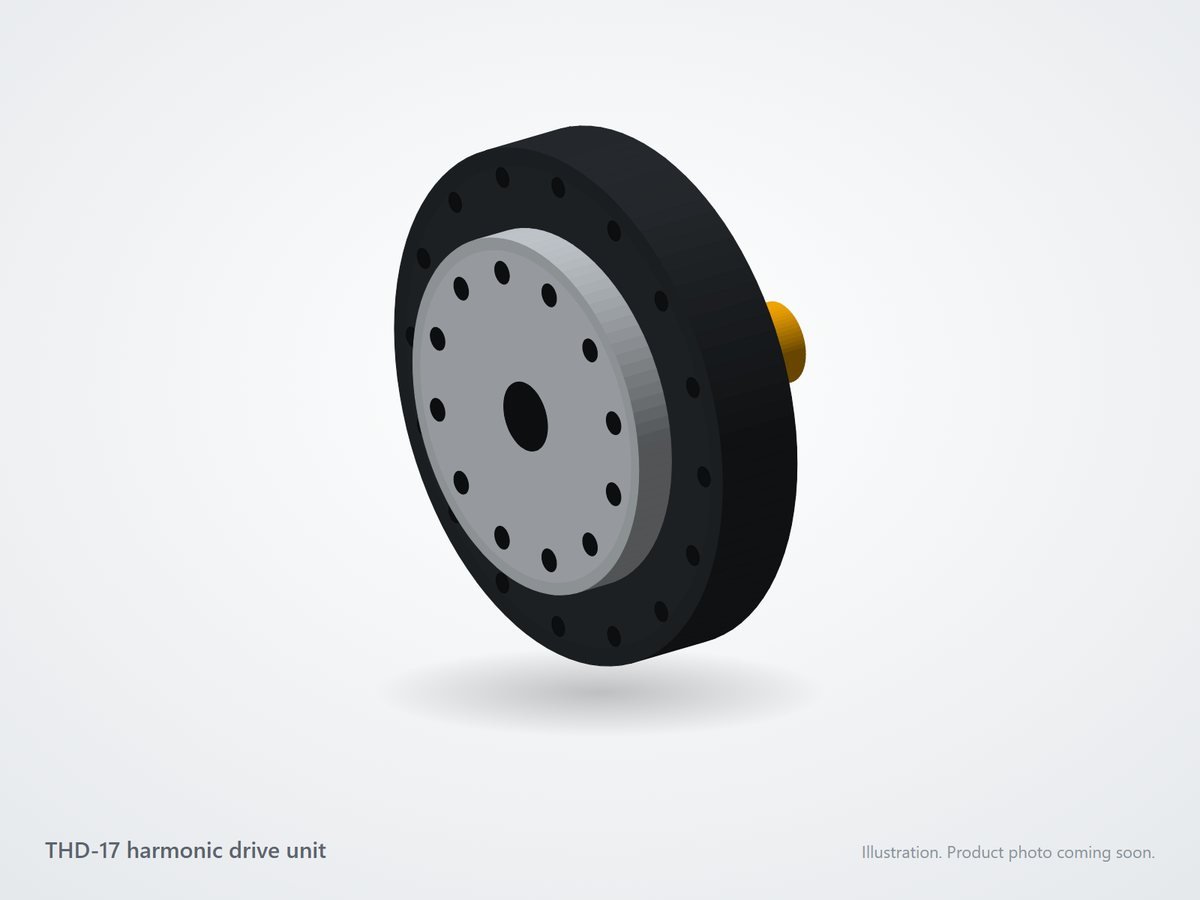
THD-17 Harmonic Drive Unit, Size 17
- Rated torque
- 21 N·m
- Backlash
- ≤ 20 arcsec
- Ratios
- 30–120:1
from ₹38,500 + GST
In stockZero-backlash class strain wave gear units, ratios 30:1 to 160:1 in a single stage, in cup and hat styles with hollow-shaft options for compact robot joints.
2 gearboxes
Zero-backlash class Harmonic driveFrame 17
from ₹38,500 + GST
In stock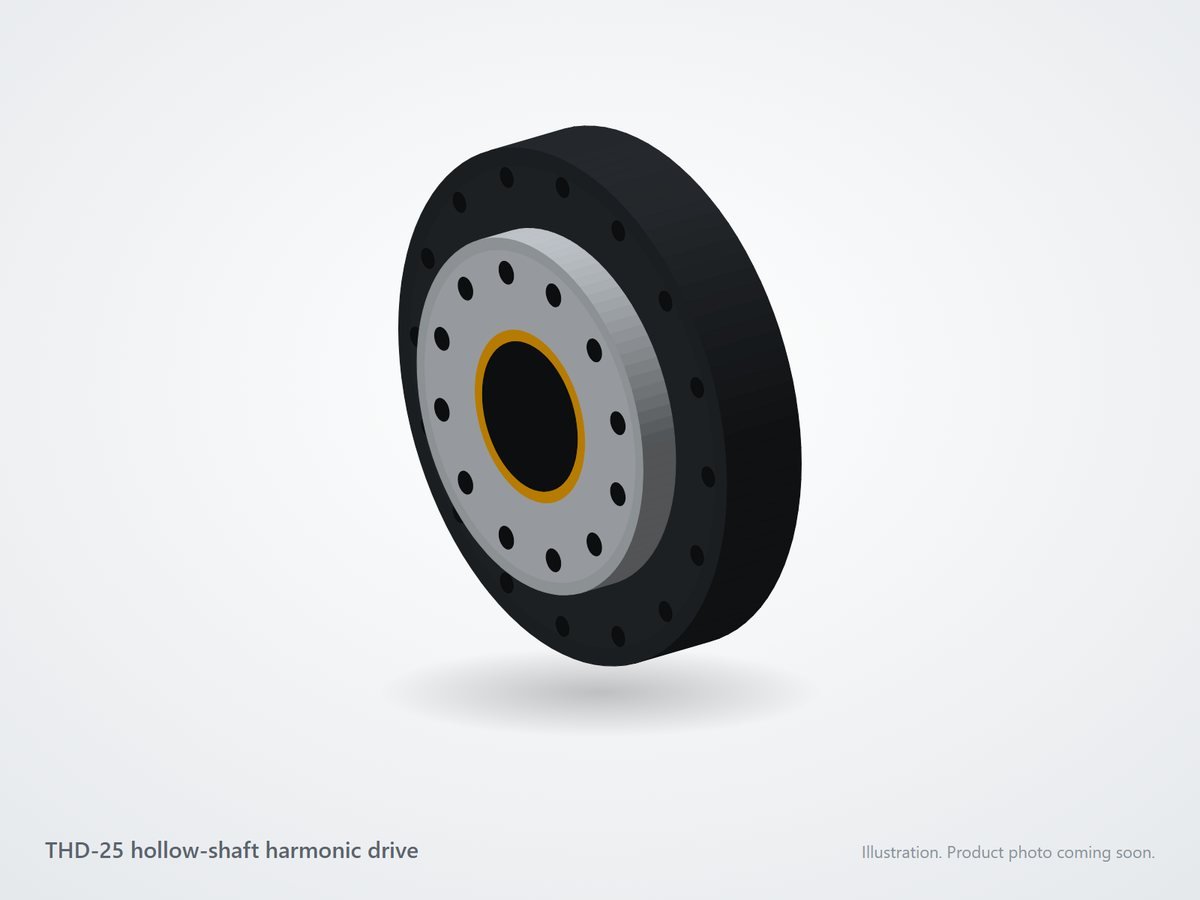 Zero-backlash class
 Harmonic driveFrame 25
from ₹56,000 + GST
In stockNo gearbox matches these filters. Loosen the torque or backlash limit, or send us your requirement and we will build one.
Request a custom gearboxChange the flexspline tooth count. The circular spline always has two more teeth, and each input turn shifts the flexspline back by those two teeth, so the ratio is flexspline teeth ÷ 2.
Turn on JavaScript to change tooth counts and see the ratio, output speed and torque update live.
Every harmonic drive can be joined to any motor, robot joint or housing: we machine a custom coupling bored to both shafts, plus an adapter flange if the mounting faces differ. Send both shaft sizes, a drawing or just the motor model number.
Get a custom couplingA harmonic drive, also called a strain wave gear, has only three parts. The wave generator is an elliptical cam with a thin ball bearing, mounted on the input shaft. It sits inside the flexspline, a thin-walled steel cup with external teeth. Around the flexspline is the circular spline, a rigid ring with internal teeth. The circular spline has two more teeth than the flexspline.
The elliptical wave generator pushes the flexspline into the circular spline at two opposite points. As the input turns, these engagement points travel around, and each full input revolution makes the flexspline shift back by two teeth relative to the circular spline. With 200 flexspline teeth and 202 circular spline teeth, that is a 100:1 reduction in a single stage with no gear train.
About 30% of the teeth are in contact at once, so torque capacity is high for the size and weight, and the preloaded engagement gives near-zero backlash. Harmonic drives are the standard reducer for collaborative robot joints, SCARA arms, humanoid and legged robots, robot wrists, satellite and telescope mechanisms, and precision rotary stages. The hollow-shaft hat style lets cables and pneumatic lines pass through the centre of the joint.
We supply harmonic gearing as component sets (wave generator, flexspline, circular spline) for builders who design their own joint housing, and as sealed units with a cross-roller output bearing that bolt directly into your robot. Custom housings and input adapters for frameless motors are available on order.
What backlash means on a datasheet, how it is measured, how it differs from lost motion and hysteresis, and a table converting arcmin to millimetres…
How much angular error your part can tolerate, which reducer meets it, and why rotary axes should clamp during heavy cuts. With an accuracy table by…
Fast pick-and-place robots need low inertia, near-zero backlash and high repeatability. How to choose and size the reducer, with a SCARA joint 1 exam…
The tooth engagement has practically no backlash because the flexspline is preloaded against the circular spline. What remains is a small hysteresis loss, typically under 1 arcmin, and the published positioning accuracy.
The flexspline of a cup type is shaped like a cup with the output on the closed end. A hat type has an outward flange, which leaves a large hollow bore through the centre for cables and shafts.
The wave generator bearing and the fatigue of the flexspline. Stay within the rated torque and average input speed, and the rated life is typically 7,000–10,000 hours at rated conditions, longer at lighter loads.
Flexing the thin flexspline and the high tooth-contact count cost some energy, especially at high input speed and low temperature. Efficiency improves near rated torque.