Application: Pick and place
Gearboxes for SCARA and delta robots: fast cycles, low backlash
Fast pick-and-place robots need low inertia, near-zero backlash and high repeatability. How to choose and size the reducer, with a SCARA joint 1 example.
Key takeaways
- SCARA joints 1 and 2: harmonic drives at 50:1 to 100:1 for light weight, near-zero backlash and hollow cable routing.
- Delta robots: precision planetary gearboxes (about 10:1 to 30:1, ≤ 3 arcmin) or low-ratio cycloidal units for heavier payloads.
- Size on the repeated peak torque during acceleration, and check the average input speed, which is high in fast pick-and-place.
Why these robots are hard on reducers
SCARA and delta robots run hundreds of short, violent moves a minute: accelerate, decelerate, settle, repeat. A robot maker's cycle time is usually quoted for the "Adept cycle" — 25 mm up, 305 mm across, 25 mm down and back — which takes well under a second on fast machines. In such a cycle the arm spends most of its time accelerating or braking, so the reducer's repeated peak torque, not its continuous rating, decides the size. Any backlash appears directly as overshoot at the end of each move and costs settling time.
Recommended gearboxes
| Axis | Reducer | Typical ratio | Why |
|---|---|---|---|
| SCARA J1 (shoulder) | Harmonic, unit type | 50–100:1 | High ratio, light, hollow bore |
| SCARA J2 (elbow) | Harmonic | 50–80:1 | Low mass at the end of the arm |
| SCARA Z / roll | Small planetary or belt | 3–10:1 | Drives a ball-screw spline |
| Delta arms (3 kg class) | Precision planetary | 10–30:1 | Efficient, ≤ 3 arcmin |
| Delta arms (heavy) | Cycloidal | 11–35:1 | Shock capacity, stiffness |
Worked example: SCARA joint 1
A SCARA arm with a 400 mm inner link and 250 mm outer link carries a 2 kg payload. With the arm fully extended (worst case), approximate the inertia about J1 with point masses:
| Item | Mass | Radius from J1 | m·r² |
|---|---|---|---|
| Inner link | 3 kg | 0.200 m | 0.120 kg·m² |
| Outer link + J2 drive | 2 kg | 0.525 m | 0.551 kg·m² |
| Payload + tool | 2 kg | 0.650 m | 0.845 kg·m² |
| Total | 1.516 kg·m² |
- Motion. A 90° move in 0.4 s with a triangular speed profile needs an angular acceleration of 4θ/t² = 4 × 1.571 ÷ 0.16 = 39.3 rad/s² and reaches a peak speed of 7.85 rad/s (75 rpm).
- Torque. 1.516 × 39.3 = 59.5 N·m at the joint. With a 1.5 factor for the repeated peaks of continuous cycling: 89 N·m.
- Ratio. At 50:1 the motor reaches 75 × 50 = 3,750 rpm, within the maximum speed of most small servos.
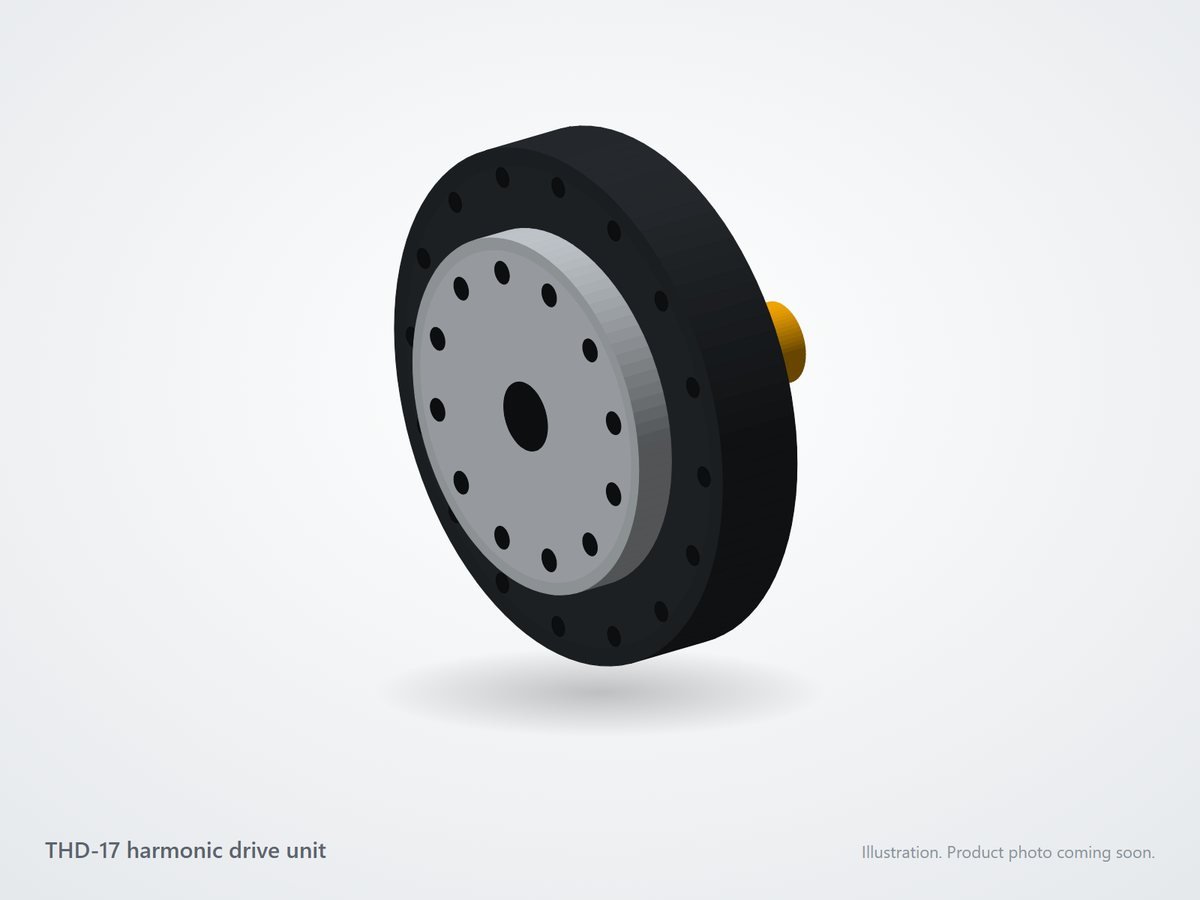
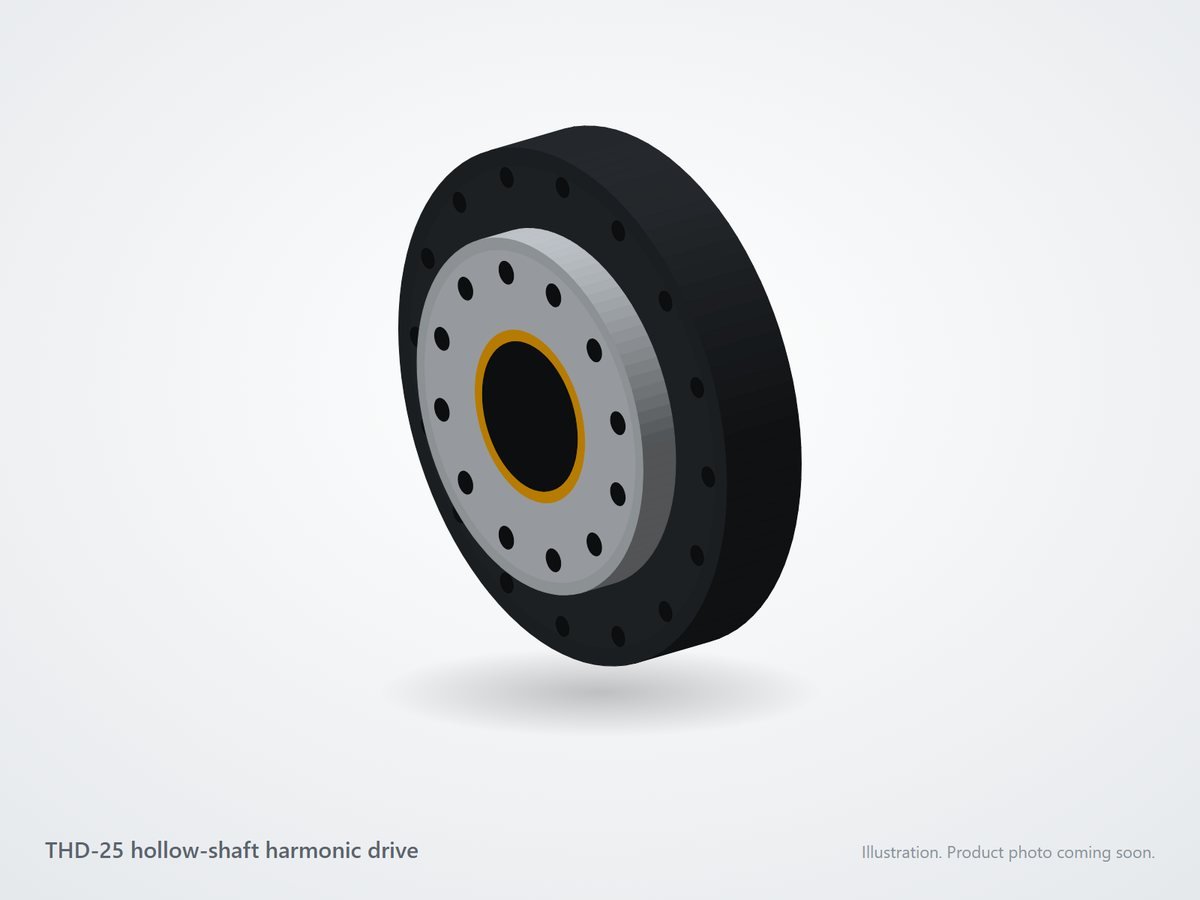
- Choice. A size 25 harmonic drive, with a repeated peak torque limit of around 127 N·m, covers the 89 N·m requirement. A size 17 (about 44 N·m) would not.
Then check that the average input speed over the cycle stays below the wave generator's average speed limit, because pick-and-place robots run close to it.
Design tips
- Keep the load-to-motor inertia ratio below about 5:1 on these axes for crisp settling.
- Use a hollow-shaft harmonic unit on J1 and J2 so vacuum lines and cables pass through the joint centre.
- Specify the output bearing's moment rating: the outer link and payload hang off the J2 bearing.
References and standards
- ISO 9283, Manipulating industrial robots — Performance criteria and related test methods.
- ISO 8373, Robotics — Vocabulary (definitions of SCARA and parallel robots).
Frequently asked questions
Which gearbox is used in SCARA robots?
SCARA joints 1 and 2 most often use harmonic drives because they give a high single-stage ratio, near-zero backlash and a hollow bore in a light package. The vertical Z axis and the tool rotation usually use a ball-screw spline driven through small planetary or belt stages.
What backlash do pick-and-place robots need?
Backlash shows up as overshoot and settling time. Joints of fast pick-and-place robots typically use reducers with backlash under 1 arcmin, or harmonic drives with practically none.
What is the Adept cycle?
A common benchmark move for SCARA robots: 25 mm up, 305 mm across, 25 mm down and back. Cycle times quoted by robot makers are usually for this path with a stated payload.